
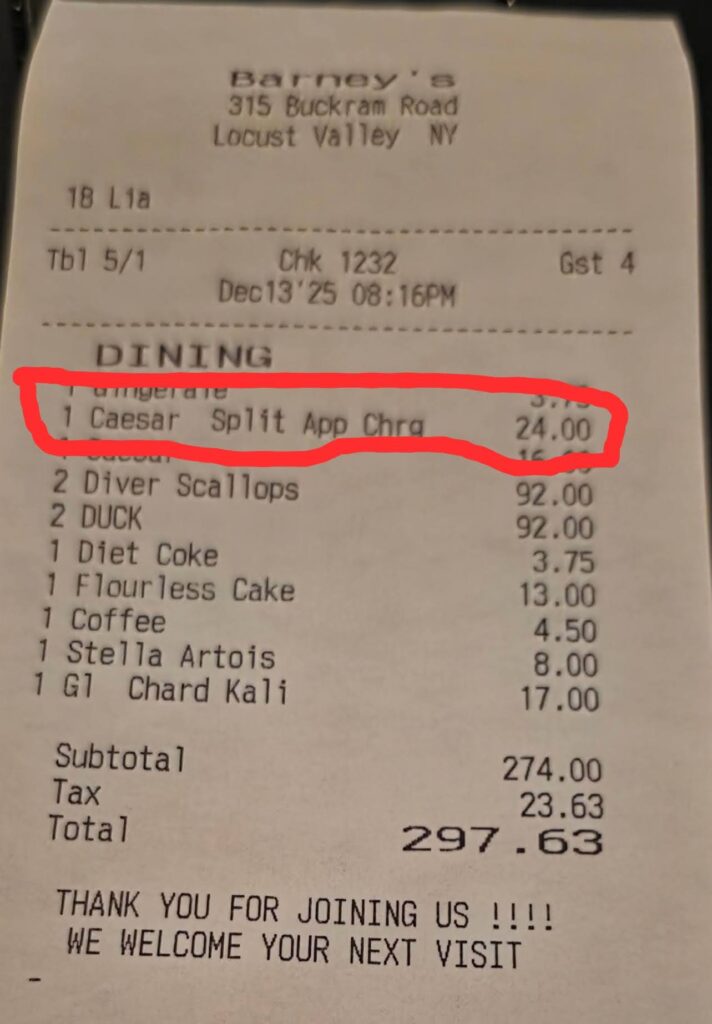
There are few things worse than enjoying a great meal only to have the bill undo the entire experience. That’s exactly what happened during a recent dinner at Barney’s in Locust Valley—a restaurant I’ve long considered a reliable choice for special occasions and romantic evenings.
Let me be clear: the food was very good, and the ambiance remains charming. Barney’s is known for its refined New American menu with French influences, an old-world feel, a cozy fireplace, and intimate tables. It’s the kind of place where you expect warmth and hospitality. Which is why what happened next was so jarring.
We began the meal the way many diners do—by sharing a Caesar salad. For entrées, I ordered Barney’s famous Long Island duck, while my wife chose the pan-seared diver scallops. The salad was $16, and each entrée was $46. Expensive but nothing out of the ordinary—until the check arrived.
There it was: an $8 split charge for the Caesar salad. That’s 50% of the cost of the appetizer, simply because we shared it.
I’ve encountered split fees before, usually on entrées and typically at casual diners—especially in places like Florida, where retirees often share meals. As I get older, maybe I’m now part of that demographic. But what I rarely see—particularly in a fine-dining setting—is a split fee for an appetizer.
My initial reaction was surprise, quickly followed by annoyance. Had we been told about the charge upfront, I would have ordered a second appetizer without hesitation. After all, we were already paying for one and a half. Sharing appetizers is not some fringe dining behavior—it’s practically the norm. In fact, one of the joys of eating out is ordering a few dishes for the table to share. I’ve even ordered entire pastas just for that purpose.
That raised an obvious question: would sharing a pasta trigger a fee too? I later learned Barney’s charges $15 to split an entrée. Would that apply to a shared pasta for the table? At some point, the message becomes unmistakable: anything shared or customized will be monetized.
I understand charging for tangible add-ons—extra protein, premium ingredients, substitutions. That makes sense. But charging simply because two people want equal portions of an appetizer feels different. Interestingly enough, we also shared a flourless chocolate cake for dessert—and there was no split charge. By the restaurant’s own logic, perhaps there should have been.
I understand why split fees exist. Restaurants need to protect their average check size and ensure tables generate enough revenue. That argument works for shared entrées. It falls apart when applied to appetizers. Many diners skip appetizers altogether and order only an entrée. Should restaurants then impose a minimum spend per table? And where do drinks factor into that calculation? If two cocktails are ordered, does that help meet the restaurant’s revenue expectations?
What diners don’t want—especially at an upscale restaurant—is to feel nickel-and-dimed. Surprise fees leave a bad taste, no matter how good the food is. Transparency would help. The simplest solution is for servers to explain the policy in advance. That didn’t happen here. Even so, I’d still object, because I don’t believe an appetizer split fee is justified.
Barney’s aims to present itself as a refined, romantic dining destination. For me, that image clashes with a fee-for-everything approach. Long Island has no shortage of excellent restaurants, and moving forward, I’ll be spending my dining dollars elsewhere. Because once surprise charges enter the picture, the experience—and the trust—is already compromised.